
Categories
Mortgage MinutePublished August 3, 2026
More Inventory, More Negotiating Power: How Seller Concessions Can Help Buyers Right Now

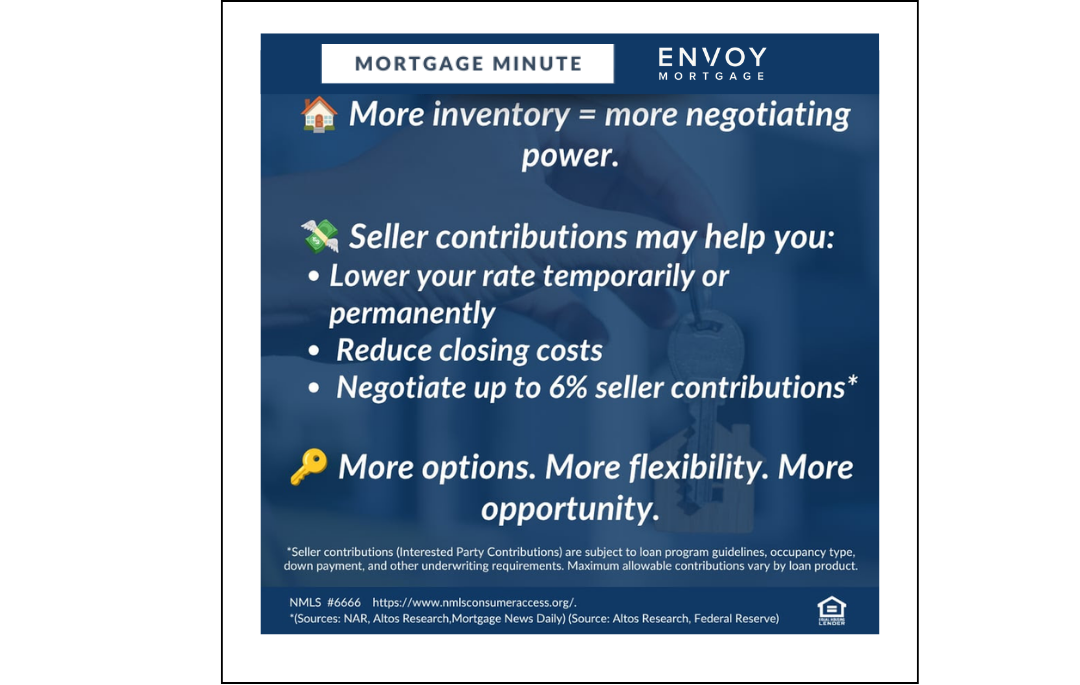
More Inventory, More Negotiating Power: How Seller Concessions Can Help Buyers Right Now
Mortgage rates moved back toward recent highs last week, with the average 30-year fixed rate ending near 6.83%, according to the Mortgage News Daily rate index dated July 31, 2026.
That number matters, but it is not the only part of today’s home buying equation.
As buyers gain more homes to choose from and some sellers face longer marketing periods, negotiations may extend beyond the purchase price. Seller concessions can sometimes help buyers lower their upfront expenses, temporarily reduce their mortgage rate, purchase discount points, or cover eligible closing costs.
For payment-conscious buyers, that flexibility may be more useful than waiting indefinitely for mortgage rates to fall.
What Happened With Mortgage Rates Last Week?
Mortgage rates faced renewed upward pressure as Treasury yields increased and Federal Reserve officials continued to express concern about inflation.
The Federal Reserve held its benchmark rate steady, but three policymakers reportedly favored a rate increase. That division reinforced the idea that inflation remains difficult to predict and that the Fed may not be ready to signal a clear path toward lower rates.
By the end of last week, the Mortgage News Daily rate index showed:
- 30-year fixed: 6.83%
- 15-year fixed: 6.32%
- 30-year FHA: 6.34%
- 30-year jumbo: 6.91%
- 30-year VA: 6.36%
These are broad national averages rather than individual loan quotes. A buyer’s actual rate can vary based on credit, loan amount, down payment, occupancy, property type, discount points, and lender guidelines.
What Could Move Rates This Week?
The next important signals will come from employment data, including July unemployment and non-farm payroll figures.
A stronger-than-expected labor report could put additional upward pressure on bond yields and mortgage rates. Softer employment data may provide some relief.
With no firm Federal Reserve direction for September, markets may react more strongly than usual to new economic reports. That can create day-to-day rate movement even when the broader housing market remains relatively steady.
Buyers do not need to predict the exact direction of the next rate change. They do need to understand how different rates, loan programs, and negotiated concessions would affect their monthly payment and cash needed at closing.
What Are Seller Concessions?
Seller concessions are funds a seller agrees to contribute toward certain buyer expenses as part of the purchase agreement.
Depending on the buyer’s loan program and underwriting requirements, those funds may be used for eligible costs such as:
- Loan and escrow closing costs
- A temporary interest-rate buydown
- Discount points for a permanent rate reduction
- Certain prepaid expenses
- Other costs permitted under the loan guidelines
Seller concessions do not automatically mean the seller hands cash directly to the buyer. They are negotiated within the transaction and applied to approved costs through escrow and the lender.
The maximum allowable contribution varies by loan type, occupancy, down payment, and other underwriting rules. The “up to 6%” figure applies only in certain circumstances and should never be treated as a universal amount available to every buyer.
A lender should confirm the allowable contribution before the offer is written.
Why Seller Concessions Matter More When Rates Are Elevated
Many buyers begin a negotiation by focusing entirely on the purchase price.
Price matters, but it does not always create the largest immediate affordability benefit.
Consider a buyer who has enough income for the monthly payment but wants to preserve cash for moving expenses, repairs, reserves, or future improvements. A seller credit toward eligible closing costs may allow that buyer to keep more money available after closing.
Another buyer may care more about lowering the monthly payment. In that case, a concession used for a temporary or permanent rate buydown may be more helpful than a small reduction in price.
The better strategy depends on the loan, the property, the buyer’s expected ownership timeline, and the seller’s willingness to negotiate.
Temporary vs. Permanent Rate Buydowns
A temporary buydown reduces the buyer’s payment during the first one or more years of the loan. The mortgage note rate does not change, but funds are set aside to cover the difference between the full payment and the temporarily reduced payment.
This may help a buyer who expects income to rise or who wants a lower payment during the first year of homeownership. The buyer still needs to qualify under the lender’s requirements, which may be based on the full note rate rather than the reduced initial payment.
A permanent buydown uses discount points paid at closing to reduce the interest rate for the life of the loan.
That may be useful for someone who expects to keep the mortgage long enough for the upfront cost to be recovered through lower monthly payments. Buyers should compare the cost of the points with the expected monthly savings and their likely ownership timeline.
Neither option is automatically better. The decision should be based on actual loan estimates rather than a general rule.
More Inventory Can Create More Ways to Negotiate
Growing inventory does not mean every seller will accept concessions.
A well-priced home in a high-demand neighborhood may still receive strong interest. A property that is new to the market may offer less negotiating room than one that has been available for several weeks.
Still, buyers may have more opportunities to negotiate when:
- The home has been on the market longer than competing properties
- The seller has already adjusted the price
- The property needs repairs or updating
- The seller is working toward a specific closing date
- Nearby listings give buyers several comparable choices
- The buyer presents strong financing and reasonable terms
This is why the current market should not be reduced to a single mortgage-rate headline. A higher rate paired with better pricing, fewer competing offers, and seller-paid costs may create a better overall opportunity than a lower rate in a highly competitive market.
Questions Buyers Should Ask Before Requesting Concessions
How much can my loan program allow?
The answer depends on the financing. Conventional, FHA, VA, jumbo, and other programs can have different contribution limits and eligible uses.
Would I benefit more from a credit or a lower purchase price?
Your lender can compare the monthly and upfront effect of each option. A concession may help more at closing, while a price reduction may affect the loan balance differently.
Is a temporary buydown appropriate for my budget?
Review the payment after the temporary reduction expires. The long-term payment should still fit comfortably within your financial plan.
How long would it take to recover the cost of discount points?
Divide the upfront cost by the estimated monthly savings to calculate the approximate break-even period. Compare that period with how long you expect to keep the mortgage.
Is the home likely to receive competing offers?
A concession request may be easier to negotiate on a property with limited activity than on a newly listed home receiving multiple offers.
Use the Cost of Waiting as a Planning Tool
Waiting for rates to fall can feel safer, but waiting also has tradeoffs.
During that time:
- Home prices may change
- Inventory may increase or decrease
- More buyers may return to the market
- Your rent or current housing costs continue
- The right property may come and go
- Your finances or loan eligibility may change
A cost-of-waiting calculator can help compare several scenarios rather than assuming that a future lower rate will automatically produce a better result.
Use the Cost of Waiting Calculator: Cost of Waiting Calculator
Treat the result as an educational estimate, not a loan quote or prediction of future prices and rates.
Frequently Asked Questions
Can a seller pay all of my closing costs?
Sometimes, but not always. The amount a seller may contribute depends on the loan program, down payment, occupancy, appraisal, purchase price, and lender requirements.
Can seller concessions be used to lower my mortgage rate?
They may be used for a temporary buydown or eligible discount points when permitted by the loan program and approved by the lender.
Is a seller concession the same as a price reduction?
No. A price reduction lowers the agreed purchase price. A seller concession is generally applied toward approved buyer costs within the transaction.
Do seller concessions make an offer less competitive?
They can affect how a seller compares offers because the concession reduces the seller’s net proceeds. The strength of the financing, price, contingencies, timeline, and competing interest also matter.
Should I wait for mortgage rates to fall before buying?
That depends on your finances, timeline, available inventory, expected ownership period, and the terms you can negotiate today. Compare real scenarios rather than basing the decision on a rate forecast alone.
More Options Can Create More Opportunity
Mortgage rates remain elevated, and short-term movement may continue as new economic reports are released. At the same time, more inventory may give buyers choices that were harder to find in a more competitive market.
The opportunity is not limited to finding a lower-priced home. It may also come from negotiating closing costs, a temporary buydown, discount points, repairs, or a timeline that better supports your plans.
EO&A can help you evaluate the property and structure an offer around your goals. A licensed lender should confirm the loan options, contribution limits, estimated payments, and costs before you make a decision.
Search Homes • Explore Financing Resources • Meet the EO&A Team
Contact EO&A today to schedule your free home value review.
Your Trusted Real Estate Advisors across Northern California
Whether you’re planning to sell in San Francisco, Marin, Napa, Sonoma, Solano, Yolo, Sacramento, Contra Costa, or Alameda County, our team has local experts ready to help you navigate your next move with confidence and strategy.
EO&A Team
Elizabeth, Anne, Ian, Ksenia, Cliff, Annie, Mike, Nina, Sidra, Karen, Annie, Elizabeth, Steven, Gladys, Venus, Najat, Courtney, and Anú
707.312.0819 • hello@eoanda.com • www.eoanda.com
DRE# 01388551 • GUIDE Real Estate DRE# 01976964
Mortgage rates shown are broad market averages and are not a commitment to lend. Rates, fees, points, and program availability can change and depend on borrower and property qualifications. Seller contributions are subject to loan-program limits, underwriting requirements, appraisal, and negotiated contract terms. Consult a licensed mortgage professional before making financing decisions.

Anne Kennedy
Broker Associate | EO&A | Real Estate in Napa, Sonoma, Solano, Marin, and San Francisco
or another way